How to Identify Five Common Woodpeckers in Your Backyard
Woodpeckers are among the most recognizable and engaging birds that visit backyards across the United States. Their rhythmic drumming, striking plumage, and distinctive calls make them a rewarding subject for observation. For anyone interested in learning more about these birds, understanding the specific markings and vocalizations of the most common species is a practical starting point. Resources such as Wild Trails provide detailed field guides that can support this learning process, but even without a guide, a few key observations can help distinguish one woodpecker from another.
Five species are particularly widespread in residential areas: the downy woodpecker, hairy woodpecker, red-bellied woodpecker, pileated woodpecker, and northern flicker. Each has a unique combination of size, color patterns, and sounds. By paying attention to these traits, backyard birdwatchers can begin to identify which species are present in their area. The following sections describe the defining features of each woodpecker, focusing on visual clues and auditory cues that are most reliable in the field.
Downy Woodpecker
The downy woodpecker is the smallest and most frequently encountered woodpecker in many backyards. Its size is comparable to that of a sparrow, which immediately sets it apart from larger species. The black-and-white plumage is marked by a white stripe down the center of the back, a clean white chest, and black wings with small white spots. Males display a small red patch on the back of the head, while females lack this mark entirely.
The call of the downy woodpecker is a soft, high-pitched “pik” or “tchick,” often repeated in a short series. Its drumming is relatively slow and steady, with a rhythm that can be described as a quick, even tap. When observing feeding behavior, downy woodpeckers often cling to smaller branches and weed stems, a habit that can help distinguish them from their larger relative, the hairy woodpecker. The bill of the downy is noticeably short and stubby, about the length of its head.
Key features to note include the overall small size, the white back stripe, and the presence of the red patch only in males. The downy woodpecker is also known to visit suet feeders frequently, making it a common sight in winter months.
Hairy Woodpecker
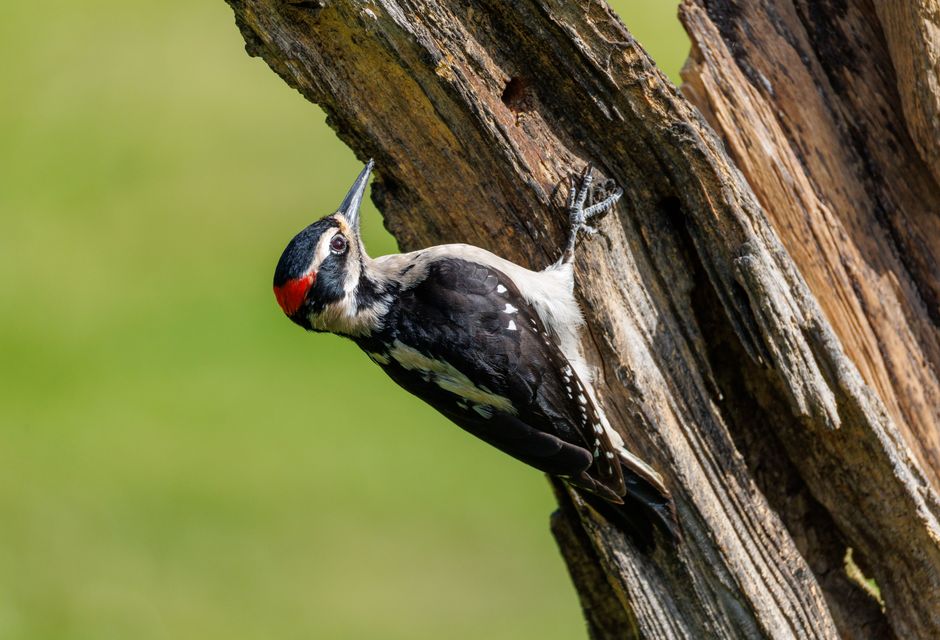
The hairy woodpecker closely resembles the downy woodpecker in coloration but is significantly larger, roughly the size of a robin. This difference in size is the most reliable visual distinction, though it can be difficult to judge without a direct comparison. The hairy woodpecker has a longer, chisel-like bill that is almost as long as its head, which contrasts with the shorter bill of the downy. Its white back stripe is narrower, and the black bars on the outer tail feathers are often more solid or unbroken.
Vocalizations of the hairy woodpecker are louder and more explosive. Its call is a sharp “peek” that carries farther than the downy’s softer note. The drumming pattern is also heavier and faster, with a series of rapid strikes that may slow down slightly at the end. Hairy woodpeckers tend to forage on larger trunks and main branches rather than on small twigs, and they prefer mature forests but adapt well to suburban areas with large trees.
Because the downy and hairy woodpeckers are so similar in pattern, focusing on bill length and overall body size is the most practical approach. A common technique is to compare the bird to a nearby branch or feeder. The hairy woodpecker’s bill appears robust and pointed, while the downy’s bill looks almost delicate.
Red-Bellied Woodpecker
Despite its name, the red-bellied woodpecker is not dominated by red plumage. Instead, the most visible feature is a bright red cap that extends from the bill to the nape in males, with females having red only on the nape. The belly usually shows a faint blush of reddish or peach-colored wash, which is often difficult to see in the field. The back and wings are boldly barred with black and white, giving the bird a zebra-like appearance when viewed from behind.
This species is medium-sized, larger than a hairy woodpecker but smaller than a pileated. Its call is a loud, rolling “churr” or “kwirr” that is often compared to the sound of a squeaky toy. Red-bellied woodpeckers also produce a sharp “chuck” note and a series of repeated “churrs” that can be heard from a considerable distance. They are frequent visitors to suet and seed feeders and are known for storing food in tree crevices.
The black-and-white barring on the back combined with the red crown provides a clear identification. In flight, the white wing patches are prominent. Unlike the downy or hairy, the red-bellied woodpecker does not have a solid white back stripe, which helps distinguish it from those species.
Pileated Woodpecker
The pileated woodpecker is the largest woodpecker commonly found in backyards, approaching the size of a crow. It is an unmistakable bird with a striking black body, a red crest, and a prominent white stripe extending from the bill down the side of the neck. In flight, the white undersides of the wings are visible, creating a flashing pattern. Males have a red line on the cheek, while females have a black line in the same area.
The call of the pileated woodpecker is a loud, far-carrying “kuk-kuk-kuk” or “wuk-wuk-wuk” that resembles the sound of a wild laugh. Its drumming is deep and resonant, often delivered in a series of powerful strikes that can be heard from a quarter-mile away. These birds create large, rectangular holes in dead trees as they search for carpenter ants, their primary food source. The size and shape of these holes are distinctive and can indicate the presence of a pileated woodpecker even when the bird is not seen.
Observing a pileated woodpecker often requires a bit of patience, as they are less frequent at feeders than smaller species. They tend to inhabit areas with mature forests, large snags, or wooded patches. When they do appear, their size and loud calls make them impossible to overlook.
Northern Flicker
The northern flicker is a unique woodpecker that spends much of its time foraging on the ground for ants rather than drilling into trees. It is a large, brownish woodpecker with a spotted chest and a black crescent bib on the upper breast. The underside of the wings and tail show a bright yellow or red coloration depending on the geographic subspecies — yellow-shafted in the east and red-shafted in the west. In flight, these vibrant underwings are a key identification clue.
The call of the northern flicker is a loud, repeated “wicka-wicka-wicka” that can be described as a cheery, rolling sound. It also produces a sharp “kleer” note and a rhythmic drumming in spring. Unlike other woodpeckers, flickers often perch on the ground or on low stumps, and their feeding behavior involves probing into soil with their slightly curved bills. They are also known to drum on metal surfaces, which amplifies the sound.
Identification is straightforward due to the brown body, spotted breast, and black crescent. The white rump patch visible in flight is another reliable field mark. Northern flickers are common in open woodlands, parks, and suburban areas, making them a frequent sight for backyard observers who keep an eye on the ground as well as the trees.